
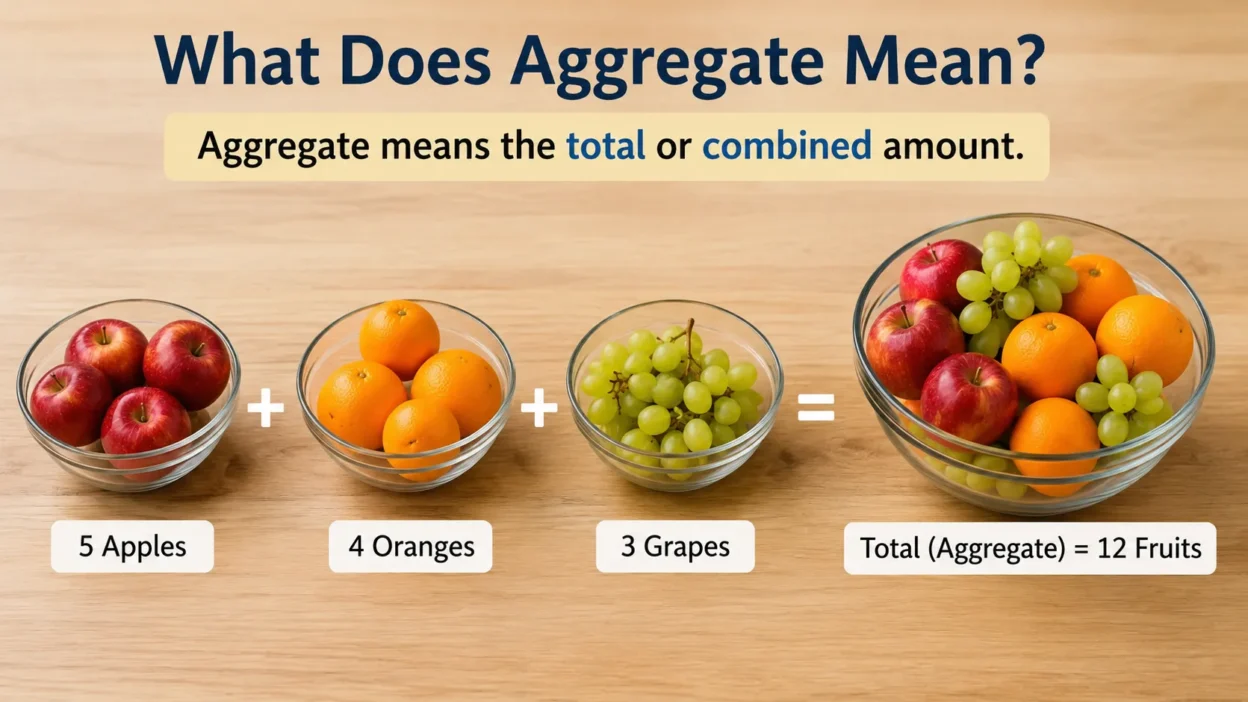
Ever been reading an article or listening to someone talk and they casually drop the word aggregate and you just nod along, pretending you totally get it? 😅 Yeah, same. Maybe you saw it in a stats report, a sports headline, or a business article and thought, “Wait… is that just a fancy word for total?” Well, sort of but there’s more to it. Let’s break it down in plain English so you never have to fake-nod again.
⚡ Quick Answer:
Aggregate means a total or combined amount made up of many smaller parts. It’s a neutral, slightly formal word used to describe collected data, scores, numbers, or materials grouped together into one whole.
🧠 What Does Aggregate Mean?
The word aggregate comes from the Latin aggregare, meaning “to add to a flock” basically, to bring things together. In modern use, it refers to a collection of individual parts or items treated as a single whole.
Think of it like this: imagine you have test scores from 10 students. Individually, each score is just one number. But when you combine all of them into one total or average? That’s the aggregate score.
It’s used both as a noun (“the aggregate of all responses”) and as an adjective (“the aggregate data shows growth”) and occasionally as a verb meaning to collect or combine.
Example sentence: “In aggregate, the team scored 240 points across all five matches.”
✅ In short: Aggregate = combined total = the sum of many parts treated as one.
📱 Where Is “Aggregate” Commonly Used?
Unlike most slang, aggregate isn’t native to texting it’s a formal-to-semi-formal term that crosses into many fields. Here’s where you’ll encounter it most:
📊 Data & Statistics ⚽ Sports Reporting 💼 Business & Finance 🏗️ Construction 📰 News & Journalism 🖥️ Tech & Software 🏫 Academic Writing
- Sports: “Liverpool won on aggregate 4–2 over two legs.” This means the total goals across both games.
- Finance: “The aggregate demand fell this quarter” meaning the total demand across all sectors.
- Data: “We’ll aggregate the survey responses before reporting.” combining data points into one summary.
- Construction: “Aggregate” literally refers to crushed stone, gravel, or sand used in concrete.
- Tech: News aggregators like Feedly or Flipboard aggregate content from many sources into one feed.
Tone level: Semi-formal to formal. Not really used in casual texting, but totally normal in professional emails, reports, and sports commentary.
💬 Examples of “Aggregate” in Conversation
Here are realistic examples showing how aggregate pops up across different contexts:
Example 1 Sports Chat
A: Did Barcelona advance to the next round?
B: Yeah! They won 3–1 on aggregate. Lost the second leg but the first game saved them 🙌
Example 2 Work Slack
A: Can you send me the sales figures?
B: Sure do you want individual store data or the aggregate for the whole region?
Example 3 Study Group
A: How did the class do on the midterm?
B: The aggregate score was 74% better than last semester honestly 📈
Example 4 Finance News
A: I don’t understand this article it says aggregate demand is falling?
B: It just means total spending across the whole economy is going down. Aggregate = the big total.
Example 5 Tech Discussion
A: What does a news aggregator actually do?
B: It pulls articles from loads of different sites into one place. Basically aggregates all your news so you don’t need 10 tabs open 😂
Example 6 Academic Email
A: Should I include each participant’s score separately in the report?
B: No, just report the aggregate one combined figure for each group is enough.
Example 7 Casual Explanation
A: I keep seeing “in aggregate” in this report what does it even mean?
B: It basically means “all together” or “when you add everything up.” Like, not individually as a whole.
🕓 When to Use and When Not to Use “Aggregate”
✅ When To Use It
- When discussing combined totals from multiple sources
- In business reports, financial documents, or academic papers
- When talking about sports scores across multiple matches
- When referring to data summaries (aggregate results, aggregate metrics)
- In tech or software contexts (data aggregation, API aggregation)
- When you want a precise, professional tone
❌ When Not To Use It
- In casual texting with friends just say “total” or “overall”
- When talking to someone who may not know the word it can confuse
- In quick, urgent chats where simplicity matters more than precision
- When you just mean “all” sometimes “total” or “combined” is cleaner
| Context | Example Phrase | Why It Works |
| Sports Commentary | “Manchester City won 5–2 on aggregate.” | Standard term in two-leg fixtures |
| Business Report | “The aggregate revenue grew 12% YoY.” | Precise, professional language |
| Friend Chat | “What’s the total score so far?” | “Total” is clearer for casual use |
| Academic Writing | “In aggregate, results suggest a trend.” | Formal, accurate phrasing |
| Everyday Email | “Overall, the feedback was positive.” | “Overall” sounds more natural |
🔄 Similar Words and Alternatives to “Aggregate”
| Word / Phrase | Meaning | When To Use |
| Total | The full sum of all parts | Everyday casual & formal use |
| Combined | Things brought together | Casual reports, sports |
| Cumulative | Growing total over time | Finance, progress tracking |
| Collective | Belonging to or shared by a group | Social or academic contexts |
| Overall | Taking everything into account | Everyday writing & speech |
| Sum total | The complete result of additions | Emphatic, slightly formal |
❓ FAQs About “Aggregate”
Q: What does “aggregate” mean in simple terms?
It means a combined total made up of many smaller parts like adding everything together into one number or group.
Q: What does “on aggregate” mean in sports?
In sports (especially football/soccer), “on aggregate” refers to the combined score across two or more games in a tie or knockout round. For example, if Team A wins 3–0 in the first leg and loses 1–2 in the second, they win 4–2 on aggregate.
Q: Is “aggregate” formal or informal?
Aggregate is semi-formal to formal. You’d rarely hear it in casual texting, but it’s very common in business, journalism, sports, and academic writing.
Q: What is the difference between aggregate and total?
“Total” is the plain, everyday word for a final sum. “Aggregate” implies the total was built from multiple distinct sources or data points it carries a slightly more technical, precise meaning.
Q: Can “aggregate” be used as a verb?
Yes! “To aggregate” means to collect or combine items into a group. For example: “The app aggregates news from 50 different sources.” This form is especially common in tech and data contexts.
Q: What does aggregate mean in construction?
In construction, aggregate refers to raw materials like gravel, sand, or crushed stone that are mixed with cement to make concrete. It’s a very different (but equally valid) definition of the same word.
Q: What is aggregate data?
Aggregate data is information that has been gathered from multiple individual records and combined into summary statistics like an average, total, or percentage rather than shown as individual data points.
Q: What is aggregate demand?
In economics, aggregate demand is the total demand for goods and services within an economy at a given time. It includes consumer spending, government spending, investment, and net exports.

George Orwell is a passionate writer and observer of human behavior, sharing insights and thoughtful messages on MsgVibes.com. He aims to inspire, entertain, and connect readers through meaningful words that resonate in everyday life.