
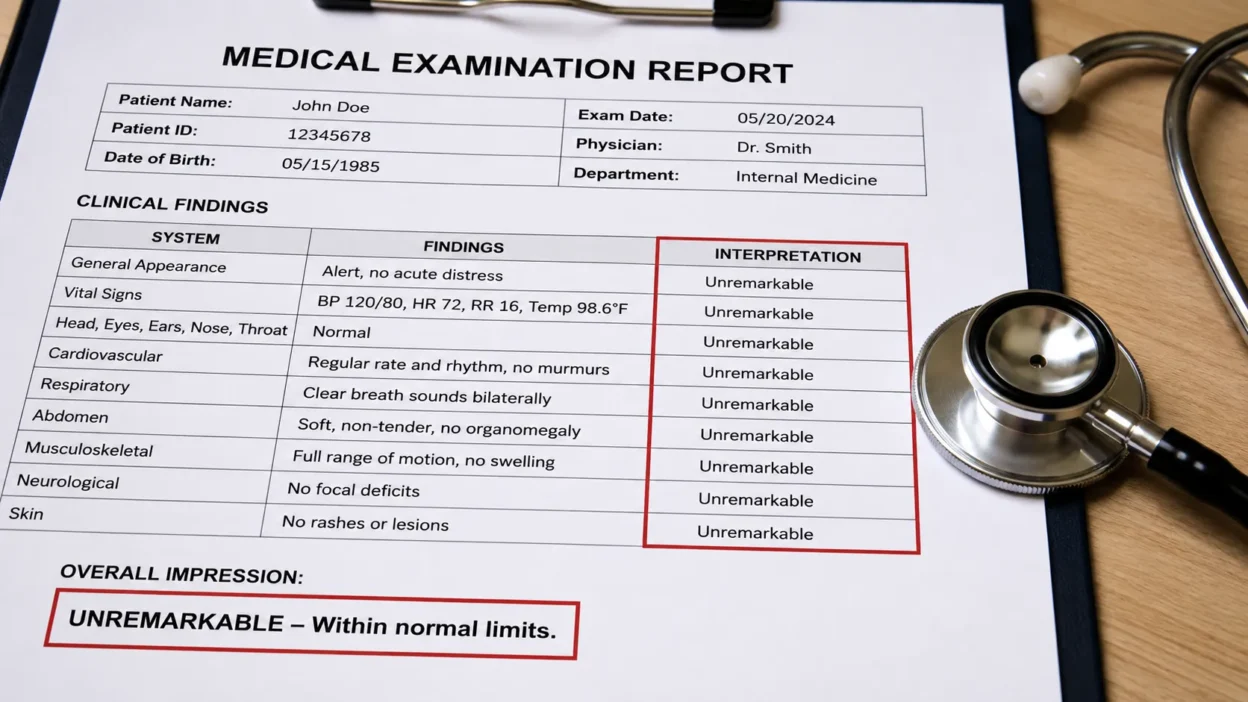
You just got your lab results or imaging report back, and there it is the word unremarkable. Your first reaction? Slight panic. Unremarkable? Is that bad? Did something get overlooked? Why is my kidney being called unremarkable? 😅
Relax, you are not alone. Thousands of people Google this exact word every day after reading a medical report and feeling confused or even a little offended on behalf of their organs.
Quick Answer:
In medical terms, unremarkable means “normal” or “within normal limits.” It’s a clinical way of saying nothing unusual, concerning, or abnormal was found. Spoiler: it’s actually great news. 🎉
🧠 What Does “Unremarkable” Mean in Medical Terms?
In everyday English, calling something “unremarkable” sounds almost like an insult it means boring, plain, or not worth noting. But in the medical world, the word carries a completely different and very welcome meaning.
When a doctor, radiologist, or pathologist writes “unremarkable” in a report, they mean:
“There is nothing abnormal, unusual, or clinically significant to report here.”
It is a standardized term used in medical documentation to indicate that a particular organ, tissue, scan result, or finding is completely normal. No masses, no lesions, no irregularities, no red flags.
Example sentence:
“The liver is unremarkable in appearance with no focal lesions identified.”
That sentence simply means: the liver looks perfectly healthy and normal.
In short: Unremarkable = Normal = Nothing wrong found. ✅
This term shows up most often in:
- Radiology reports (MRI, CT scan, X-ray, ultrasound)
- Pathology reports (tissue and biopsy analysis)
- Physical examination notes
- Lab result summaries
Doctors use it because it’s efficient one precise word that communicates “no action needed here.”
📱 Where Is “Unremarkable” Commonly Used in Medicine?
The word unremarkable pops up across nearly every branch of medicine. Here’s where you’re most likely to encounter it:
- 🖥️ Radiology Reports “The brain MRI is unremarkable for age.” Means the brain scan shows no abnormalities for the patient’s age group.
- 🔬 Pathology Notes “Lymph nodes appear unremarkable.” No signs of disease or cancer.
- 🩺 Physical Exam Summaries “Cardiovascular exam unremarkable.” Heart and circulation appear normal.
- 🏥 Discharge Summaries Used to quickly summarize which systems were checked and found normal.
- 📋 Surgical Reports Organs observed during surgery that looked healthy are described as unremarkable.
- 💉 Specialist Consultations Neurologists, cardiologists, and others use it to flag what didn’t need attention.
Is it formal or casual? Strictly formal and clinical. You will never see this word used casually in a text message or on social media it belongs entirely to the professional medical and scientific writing world. 🏛️
💬 Examples of “Unremarkable” in Medical Conversations & Reports
Here are 6 realistic examples showing how this word appears in real medical contexts:
1. CT Scan Report
Doctor’s Report: “CT abdomen and pelvis is unremarkable. No free fluid or lymphadenopathy identified.” Translation: Everything in the abdomen looks totally normal.
2. Patient & Doctor Conversation
Patient: “My report says my kidneys are unremarkable should I be worried?” Doctor: “Not at all! That just means your kidneys look completely healthy. 😊”
3. MRI Brain Report
Report: “MRI of the brain is unremarkable with no evidence of acute infarct or mass lesion.” Translation: No stroke, no tumor, nothing concerning found.
4. Physical Exam Notes
Chart Note: “Respiratory exam unremarkable. Lungs clear to auscultation bilaterally.” Translation: Lungs sound perfectly normal.
5. Post-Surgery Notes
Surgeon’s Report: “The gallbladder appeared unremarkable upon visual inspection.” Translation: The gallbladder looked healthy during the operation.
6. Ultrasound Report
Report: “Thyroid is unremarkable in size and echogenicity.” Translation: The thyroid is normal in size and texture.
7. Cardiology Consult
Patient (texting friend): “just got my echo results said heart is unremarkable lol” Friend: “wait is that bad??” Patient: “no it means normal!! freaked me out too 😅”
🕓 When Doctors Use “Unremarkable” and What It Signals
Understanding when this word appears (and what it’s telling you) can ease a lot of anxiety.
✅ When “Unremarkable” Is Used:
- When a scan, test, or exam shows no abnormalities
- When an organ or system is functioning within normal limits
- When a doctor wants to efficiently document that no further investigation is needed for that finding
- When results are age-appropriate and expected for the patient
- When comparing to previous results and finding no significant change
❌ When You WON’T See “Unremarkable”:
- When there is an active disease, lesion, or mass present
- When results are outside normal reference ranges
- When a finding requires follow-up or treatment
- When there is uncertainty that needs further testing
- In urgent or emergency report sections flagging critical values
Comparison Table: “Unremarkable” vs. Other Medical Language
| Medical Term | What It Means | What It Signals |
| Unremarkable | Normal, no issues found | ✅ Great news nothing to act on |
| Within normal limits (WNL) | Results fall in healthy range | ✅ Same as unremarkable |
| No acute findings | Nothing urgent or new | ✅ No emergency present |
| Mild abnormality noted | Small issue found | ⚠️ May need monitoring |
| Significant finding | Something important detected | 🔴 Needs attention or treatment |
| Consistent with… | Matches a known condition | 🔍 Diagnosis being made |
🔄 Similar Medical Terms and Alternatives to “Unremarkable”
Doctors use several phrases that carry the same or very similar meaning. Here’s a handy reference table:
| Medical Term | Meaning | When It’s Used |
| Within Normal Limits (WNL) | Results are in the healthy range | Lab reports, vital signs |
| No Acute Findings | Nothing urgent or new detected | Radiology, emergency notes |
| Normal | Exactly as expected | General exams and reports |
| Grossly Intact | Visually appears whole and normal | Surgical/pathology notes |
| No Significant Abnormality (NSA) | Nothing important found | Imaging reports |
| Negative | No signs of what was being tested for | Cancer screenings, infections |
| Benign Appearance | Looks non-threatening | Masses or growths under review |
All of these phrases signal that what was examined is healthy and not a cause for concern just expressed in slightly different clinical language depending on context.
❓ FAQs About “Unremarkable” in Medical Terms
Q: Is “unremarkable” good or bad in a medical report? It’s good news! It means the area examined is completely normal and nothing worrying was found.
Q: Why do doctors use the word “unremarkable” instead of “normal”? Both are used interchangeably, but “unremarkable” is a precise clinical term meaning there is nothing worth remarking upon it’s efficient and universally understood in medical documentation.
Q: If my scan says “unremarkable findings,” do I still need a follow-up? That depends on your overall diagnosis and doctor’s recommendation. The unremarkable finding itself doesn’t require follow-up, but your doctor may still want to monitor other aspects of your health.
Q: What does “unremarkable for age” mean? It means the results are normal and appropriate for your specific age group. Some changes are expected with age, and this phrase confirms nothing beyond age-appropriate findings was detected.
Q: Can one part of a report be unremarkable while another part has findings? Absolutely. Reports often list multiple organs or systems some may be unremarkable (normal) while others have specific findings that need attention.
Q: Does “unremarkable” appear in mental health reports too? Yes. A clinician may note “mental status exam unremarkable” to indicate that mood, cognition, and behavior all appeared within normal range during the evaluation.
Q: Should I ever be concerned if my report uses the word “unremarkable”? No seeing “unremarkable” is one of the most reassuring things you can find in a medical report. If there’s anything concerning, the report will use very different language like “abnormal,” “lesion,” “mass,” or “requires follow-up.”

George Orwell is a passionate writer and observer of human behavior, sharing insights and thoughtful messages on MsgVibes.com. He aims to inspire, entertain, and connect readers through meaningful words that resonate in everyday life.