Picture this: you’re sitting in biology class, half-asleep, when your teacher suddenly writes “heterozygous” on the board and everyone around you nods like they totally get it. You quietly Google it under your desk, find a definition full of even more confusing words, and close the tab more confused than before. Sound familiar? You’re definitely not alone.
Whether it’s popping up on a worksheet, in a genetics report, or on your favorite science TikTok, this word can feel intimidating at first but it’s actually pretty simple once it’s broken down.
Quick Answer:
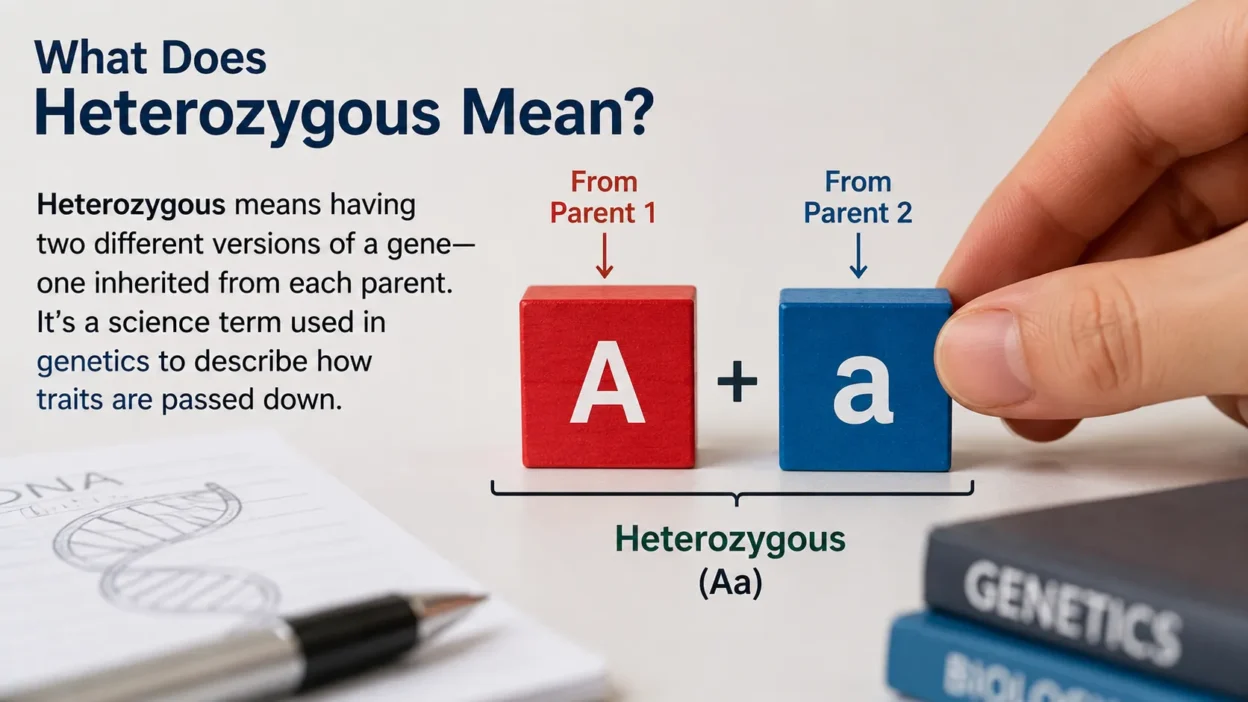
Heterozygous means having two different versions of a gene one inherited from each parent. It’s a science term used in genetics to describe how traits are passed down.
What Does Heterozygous Mean in Text?
Unlike most slang terms, heterozygous isn’t a texting abbreviation it’s a real scientific word from the world of genetics. It comes from two Greek roots: hetero (meaning “different”) and zygous (relating to a fertilized egg or “zygote”).
In genetics, every living thing inherits two copies of each gene one from the biological mother and one from the biological father. When those two copies are different from each other, the organism is called heterozygous for that particular gene or trait.
For example, if someone inherits one gene for brown eyes and one gene for blue eyes, they are heterozygous for eye color. Typically, the dominant version of the gene (in this case, brown) is the one that shows up physically.
In short: Heterozygous = Two Different Gene Copies = Mixed Alleles from Each Parent
In everyday conversation and especially in science classes, genetics apps, DNA ancestry results, or medical reports, you might see this term used to describe why someone looks a certain way, carries a genetic condition without showing symptoms, or passes a trait to their children.
Where Is “Heterozygous” Commonly Used?
Even though it’s not a piece of internet slang, you’ll actually encounter this word more often than you’d think. Here’s where it tends to pop up:
Biology Class
Lab Reports
DNA Tests
Science TikTok
Medical Results
Research Papers
Genetics Games
Edu YouTube
It’s primarily a formal scientific term used in academic, medical, and educational contexts. However, thanks to the boom in at-home DNA kits like 23andMe and AncestryDNA, it now also shows up regularly in personal conversations when people share their results online.
Examples of Heterozygous in Conversation
Here’s how “heterozygous” might actually show up in real conversations from study chats to DNA discovery moments:
Alex
wait so what does it mean if my punnett square has Bb?
Sam
that means you’re heterozygous! one dominant B and one recessive b 🧬
Mom
your genetic report says you’re heterozygous for the BRCA1 gene… should we be worried?
You
it just means i have one normal copy and one variant copy. the doctor said we’ll monitor it. don’t panic yet 💙
Jordan
my 23andMe said I’m heterozygous for lactose intolerance lol
Riley
so you CAN have cheese but maybe not a whole bowl of ice cream 😂
Student
is Aa heterozygous or homozygous?
Tutor
heterozygous two DIFFERENT alleles. if it were AA or aa, that’d be homozygous ✅
Dev
both my parents have brown eyes but i got blue eyes, how???
Priya
they were probably both heterozygous for eye color carrying a hidden blue allele they passed to you 👀
Teacher
can someone give me an example of a heterozygous genotype?
You
Tt tall plant with one dominant T and one recessive t allele!
When to Use and When Not to Use “Heterozygous”
✅ When to Use
- In biology homework or lab reports
- Explaining Punnett squares to a friend
- Discussing DNA ancestry results
- In a genetics-related medical context
- Science TikToks or edu content
- Study sessions and tutoring
❌ When Not to Use
- Casual small talk (sounds overly technical)
- Non-science conversations
- With people unfamiliar with genetics
- As slang or a shorthand (it’s not one)
- To sound impressive in unrelated chats
- In creative writing without context
Context Comparison Table
| Context | Example Phrase | Why It Works |
| Science Class | “This organism is heterozygous for trait X.” | Accurate, expected terminology |
| Study Chat | “Bb is heterozygous, right? 🧬” | Casual but still correct use |
| Medical Report | “Patient is heterozygous for the MTHFR variant.” | Clinical, precise, professional |
| DNA Results | “I’m heterozygous for this marker one copy from each parent.” | Informative and personally relevant |
| General Talk | “I carry one copy of that gene.” (simplified) | Clearer for non-science audiences |
Similar Words and Alternatives
| Term | Meaning | When to Use |
| Homozygous | Two identical copies of a gene (AA or aa) | When both alleles match |
| Dominant | The gene version that shows up in appearance | Describing which trait is expressed |
| Recessive | A gene version hidden when paired with a dominant one | Explaining hidden traits or carriers |
| Carrier | Person with one copy of a recessive gene who doesn’t show symptoms | Medical genetics conversations |
| Allele | A specific version of a gene | Any genetics discussion |
| Genotype | The actual genetic makeup (e.g., Bb, TT) | When referring to the gene combination itself |
FAQs About Heterozygous
Is being heterozygous good or bad?
Neither! It simply describes your genetic makeup. In many cases, being heterozygous can actually be protective for example, being heterozygous for sickle cell trait provides some resistance to malaria.
What’s the difference between heterozygous and homozygous?
Heterozygous means your two gene copies are different (like Bb). Homozygous means both copies are the same (like BB or bb).
Can you be heterozygous and not show a trait?
Yes! If you’re heterozygous for a recessive trait, the dominant gene “masks” it. You carry the gene but don’t show it making you a carrier.
What does heterozygous look like in a Punnett square?
In a Punnett square, heterozygous is written as two different letters for example Bb, Aa, or Tt. One uppercase (dominant), one lowercase (recessive).
Does heterozygous mean I’ll pass the trait to my kids?
It depends! A heterozygous parent has a 50% chance of passing either allele to a child. Whether the trait appears depends on what the other parent passes and which version is dominant.

Ernest Hemingway is a passionate writer and storyteller, dedicated to sharing meaningful messages that inspire, motivate, and connect people. Through his work on MsgVibes.com, he brings thoughtful insights and heartfelt words to readers around the world